Monday, April 16, 2007

Organic apparel becomes fashionable

No longer just scratchy hemp frocks for hippies, organic clothes are riding the green fashion craze into consumers closets this spring.
Looking to capitalize on the popularity of eco-conscious products that have gained mainstream acceptance in grocery stores and car dealers, merchants from H&M to Barneys New York are hawking new collections of organic garments.
"All the retailers are rushing to organic. You can't afford not to. It appeals to the two biggest markets: youth and the baby boomers," said Marshal Cohen, chief retail analyst at NPD Group, a Port Washington, New York, research firm. "It's cool to care today. Five years ago, it was self-indulgence. Now it's self-indulgence with concern." (INTERNATIONAL HERALD TRIBUNE)

Monday, February 05, 2007

Will Coach become too popular?


The stylish handbag maker had a blowout quarter. But rapid expansion may jeopardize its upscale image. Read more via Business Week

Sunday, January 28, 2007

A vending machine for iPods?

Old-school vending machines, bulky bastions of high-calorie snacks and sodas, meet your new-school challenger: chic upscale gadgets stocked with consumer electronics and pricey cosmetics. As more of these machines pop up in high-traffic areas such as airports, the old quarter-chuggers may someday find themselves out-vended. The new vending machines sell iPods, cellphones, USB drives, headphones, DVDs, and a host of other gadgets. (CHRISTIAN SCIENCE MONITOR)
[ READ MORE... ]
Retailers try on dressed-up fitting rooms


Strewn with hangers, clothes and pins, fitting rooms — when you can find them — have long been one of retail's afterthoughts. Determined to make the most of every inch of selling space, retailers lavishly displayed fashions on the sales floor and left veritable closets for the trying on.
When Macy's asked customers what they most wanted to see improved in their stores, dressing rooms, wider aisles and more directional signs were most often mentioned. So when parent company Federated (FD) began redesigning its now-800-store Macy's chain last year, it invested more money in the dressing-room area than anywhere else. (USA TODAY)

[ READ MORE... ]

Saturday, December 23, 2006

H&M moves up with Madonna


Swedish retail giant H&M Hennes & Mauritz is facing tougher competition and slowing sales growth. So the king of affordable "fast fashion" is raising the ante with a long-awaited expansion into Asia, a new upscale chain in Europe, and a high-profile collaboration with pop star Madonna. (BUSINESSWEEK)

Wednesday, October 25, 2006

Guess taps new retail behavioral marketing firm MyBuys


Online retailers Guess, Ritz Camera and Hancock Fabrics tapped new behavioral marketing firm MyBuys to improve relevant targeting in e-mail.

MyBuys, Redwood City, CA, asks consumers what kind of information they want to receive when visiting a retailer’s Web site in order to send custom and permission based e-mail and RSS messages.

“Instead of offering a one-size-fits nobody e-mail newsletter, we gather preferences from consumers on a client’s Web site and then search the retailer’s Web site for stock and send relevant promotions,” said Paul Rosenblum, vice president of marketing at MyBuys.

MyBuys asks consumers what kinds of products they are specifically interested in, such as black pants or red sweaters, in order to create promotions based on these preferences. The MyBuys platform takes this information and scans the retailer’s database for stock and size and promotional emails are sent to notify customers when a particular type of product goes on sale or when a new product is listed on the site.

Retailers pay based on performance, so MyBuys profits based on click-through sales or revenue share.

“We earn revenue when our clients do and the results are high,” Mr. Rosenblum said. “We don’t send a message unless there is something to send, as a result people are interested and we have a high conversion rate.”

Monday, October 16, 2006

Colette 2.0

The Colette store in Paris is as frustratingly annoying as it is fantastic, we can never decide. But their new website is very very good. (COLETTE.FR)
CLICK TO VISIT THE COLETTE WEBSITE
A new way to drink water

Have you ever thought there would be more than one way to drink water? Well, what if you wanted to quench your thirst in style? Well, there is an answer to that as well.

Bling Beverages, LLC have just announced the release of Bling H2O, a new drinking water aimed at the super-luxury consumer who wants to do more than just quench their thirst, according to their press release. (BALLERSTATUS)
[ READ MORE... ]
CNN aims to extend brand at conferences

CNN is seeking to bring its brand to life beyond television sets, personal computers and cellphones by forming a division devoted to event marketing. The new division, CNN Events, under the auspices of the advertising sales department, will put on panels, conferences and meetings on news-related subjects.

Although the events will not be televised on CNN, the network's reporters and anchors will serve as speakers and moderators. The events will be sponsored by CNN advertisers, who will be acknowledged on invitations and at the conferences. But CNN executives say sponsors will have no control over the content of the events. (THE NEW YORK TIMES)
[ READ MORE... ]
New ad for Bently...


...Or spoof?
Puma aims to triple number of stores

Puma, the German sporting goods company, on Wednesday set an ambitious target of tripling the number of retail stores worldwide and in the US by 2010.
The "sports lifestyle" brand has in recent years diversified its wholesale business into retail, and has more than 80 stores worldwide. (FINANCIAL TIMES, UK)
[ READ MORE... ]
Virgin Atlantic plans Virgin America

Still-grounded startup airline Virgin America popped the bubbly for its new plane “Jefferson Airplane” on Wednesday in a marketing event of grand proportions as business politicians and business people eagerly awaited the jobs and contracts the new aviation firm could bring.
A San Francisco International Airport hangar was packed with Virgin’s approximately 90 employees, as well as politicians and businesspeople already contracting with or hoping to do business for the new airline. (THE EXAMINER)
[ READ MORE... ]
Starbucks takes unique approach to marketing

While McDonald's was lovin' it, Coca-Cola was the real thing and Nike wanted us to just do it, Starbucks was throwing parties instead.
The coffee retailer, based in Seattle, takes an unconventional approach to marketing, choosing parties and other in-person encounters over big national advertising campaigns. (THE SEATTLE TIMES)[ READ MORE... ]
The Happy New House


I make my living as a creative director at an entertainment advertising agency. I’m always thinking about branding, product positioning, and creative solutions that stay “on message.” So I decided to apply a similar process to our home remodel (which I call The Happy New House). Here’s why:
1. It’s fun.

2. It creates a common language for homeowner and architect to discuss creative development.

3. It helps everyone stay “on message.” (Our key strategy: Stay connected as a family. Our core tactic: Create public realms to encourage “elbow-rubbing” opportunities. Our creative filter: Love. Heart. Happiness.)

4. It’s political. Corporations spend millions of branding-dollars trying to "own" concepts like "happiness" "loyalty" and "family" in the minds of consumers. But those concepts DON'T belong to corporations. They're ours. And we aren’t simply "consumers." We're people: Moms, Dads, and kids – making our way in the modern (and sometimes scary) new world. The "family brand" attempts to level the playing field of corporate influence by taking back what we care about most: Our relationships with each other. (NOT our relationships with McDonalds.) (ARCHINECT.COM)
[ READ MORE... ]
Wal-Mart's aesthetic evolution

You don't typically head to a Wal-Mart store because of the soothing architecture. But that might change. Stung by criticism that its massive stores are eyesores that don't blend well with the communities in which they are located, Wal-Mart is unveiling a new look that foreshadows a significant shift for Canada's largest retailer. (TORONTO STAR)
[ READ MORE... ]

Saturday, October 07, 2006

YOUR LOTIONS AND POTIONS are now cleared for boarding again -- as long as you can find some bottles small enough to put them in.

Last week, the Transportation Security Administration relaxed its ban on most liquids and gels, which had effectively made carrying on your toiletries in your wheelie bag impossible. Now, travelers can pass through security checkpoints (and board commercial airline flights) with whatever toiletry they wish, as long as the items meet two conditions. First, you must store them in bottles or containers that hold no more than three ounces. Second, you must place all of these vessels into one clear, quart-size, plastic zip-top bag.

For travelers with no particular brand preferences, grabbing whatever happens to be in the travel-size bins at the local drugstore will likely suffice. Others can turn to several Web sites that either sell miniature bottles of shampoo and such or small containers into which you can pour your own favorites. Minimus.biz, for example, limits its inventory to toiletries (plus food, cleaning supplies and other ephemera) in three-ounce containers or less.
Here are some sites that offer toiletries or containers in Lilliputian sizes.

Site: containerstore.com
Offerings: Select "Shop by Category" from the drop-down menu, click "Travel" then "Bottles and Medication." The opaque aluminum bottles are TSA-legal, but you might want to buy the company's "Personal Care Labels" so you know what you put in there. Some models promise a leakproof "laboratory quality seal."
Sample price: Two-ounce Wide-Mouth Leakproof Bottle, 99 cents each; set of 36 Personal Care Labels, $1.79

Site: minimus.biz
Offerings: A wide selection of travel-size toiletries, free shipping for domestic, FedEx ground-shipped orders over $20 and a free plastic bag to use at the airport if you enter "ZIPLOCK" in the special instructions box during checkout.
Sample price: One-ounce Lubriderm Lotion, 79 cents.

Site: www.sks-bottle.com
Offerings: Snazzy blue, green and amber plastic bottles, though the site often requires you to buy in bulk. It also peddles travel kits with several bottles inside.
Sample price: 48 two-ounce blue plastic bottles with silver caps, $22.56
FIERCE RIVALS J.C. Penney Co. and Kohl's Corp. have big plans for this weekend, and the name of the game is expansion.


Kohl's is staging grand openings at 65 stores, the largest growth spurt in its history. At the same time, plans call for Penney to cut ribbons to open 20 stores -- its biggest expansion in two decades, and one with a new wrinkle: Of the 20, 17 of the stores are free-standing -- a matter of course for Kohl's but a departure from Penny's longtime role as an anchor in suburban shopping malls.

Both Penney, based in Plano, Texas, and Kohl's, based in Menomonee Falls, Wis., plan to celebrate their growth with big discounts on fall fashions.

That will help set the tone for a highly competitive holiday season as the two battle for the business of the middle-market shopper, says Britt Beemer of America's Research Group, a consulting firm that tracks shopping patterns nationwide. "We're already seeing big, in- your-face discounts of 30% to 50% off," he says. "This is going to be a good fight to watch."

The middle market, sandwiched between discounters at the low end and luxury retailers at the top, is actually growing more slowly than retail spending overall. This holiday season, middle-income shoppers are less likely to increase their spending than their lower- and upper-income counterparts, according to a recent survey by NPD Group, a market-research firm. But Penney and Kohl's are growing faster than other midprice department stores, and both companies raised their profit outlooks this week.

"We're taking share from somebody," says Myron "Mike" Ullman, Penney's chairman and chief executive. "We're getting new customers whether they're trading up, down or sideways."

Fe Limboc, a 55-year-old accounting analyst in Lewisville, Texas, says she shops at both Penney and Kohl's stores because traditional mall department stores are "expensive for what you get."

Both chains now have an opportunity to attract customers who once shopped at hundreds of former Filene's, Foley's and Strawbridge's stores that Federated Department Stores Inc. last month converted to Macy's, a chain with a more upscale image than many of those it is supplanting. Federated also has been closing stores in the wake of its acquisition of May Department Stores Co.

Richard Hastings, an analyst at New York-based retail consultant Bernard Sands, reckons Penney and Kohl's lately are stealing shoppers away from discounters, too. He cites both companies' strong September sales gains versus those of Wal-Mart Stores Inc. and Target Corp.

The shift in strategy at Penney -- which operates about 1,050 stores -- comes as regional mall construction has nearly ground to a halt, and time-strapped shoppers are favoring stores that are closer to home and easier to navigate. Capitalizing on that trend, Kohl's has expanded at a torrid pace, doubling the size of its chain to about 800 stores since 2001 by pushing into new markets like Florida and California. What remains to be seen is whether there are enough good free-standing locations for both companies' big expansion plans.

The stand-alone strategy also isn't a slam dunk. Penney has been tinkering with its free-standing format for three years, opening only 25 such stores prior to this weekend's rollout. And while these types of stores have advantages over mall anchors -- Penney says weekday traffic has exceeded its expectations -- other chains, including Sears Holdings Corp., have seen mixed results with them.

In recent years, Penney has concentrated on updating its fashions, adding a lower-price line by designer Nicole Miller and home furnishings by Chris Madden, for example. It has also beefed up private-label brands such as St. John's Bay clothes and Arizona jeans, which now account for more than 40% of its sales.

This week, Penney announced a deal to sell two new, exclusive lines of apparel, accessories and jewelry from Liz Claiborne Inc. -- Liz & Co. for women and Concepts for men. Both will launch next spring.

Mr. Ullman predicts that free-standing Penney stores will give Kohl's a run for its money with better service and more exclusive brands. In addition to hair salons and spas, some new stores, including a free-standing location opening this weekend in Fort Worth, Texas, will feature Sephora cosmetics boutiques. He also says departments from jewelry to home decor will be staffed with more sales people than at Kohl's. But like Kohl's, Penney will provide shopping carts at its off-mall locations.

Kohl's, which has grown by discounting name brands like Gloria Vanderbilt and Levi's jeans and Adidas athletic wear, also is expanding its stable of private labels with lines like Daisy Fuentes women's sportswear. Last year, it began carrying the Chaps label from Polo Ralph Lauren Corp. And in August, it signed a deal for an exclusive midprice line from designer Vera Wang. This week, the company attributed a surprisingly strong 16% increase in September same-store sales partly to its efforts to make its stores more "feminine."

"We've broadened our reach," Kohl's President Kevin Mansell says. "We're moving from a family-focused-only approach to include women at home without children."

Mr. Mansell adds that the wide-aisled "race-track" design of Kohl's stores reduces the need for staffing. "We're not doing our job in merchandise presentation or replenishment if our customer has to ask for a lot of help," he says. "They should be able to navigate with visual cues and signing."

In its new stores, however, Kohl's is enlarging fitting rooms and installing them with three-way mirrors. Nearby lounge areas are getting hardwood floors and more decorations. The checkout stations have been redesigned so clerks spend more time facing customers, rather than cash registers. New display windows out front will showcase mannequins in the latest fashions.

Stores cluttered with racks of merchandise have drawn complaints in the past, Mr. Mansell acknowledges. But he says they are being addressed with better displays. "We're carrying less inventory, and it's delivered more often," he says.

Some analysts, meanwhile, are skeptical about both companies' big expansion plans, saying the two will eventually fight over key locations as space gets tighter.

"If they do go head-to-head on too many sites, their rents are going to go up," Dennis Yeskey, national director for real-estate capital markets at Deloitte, says of Penney's plan to open as many as 400 more stores and Kohl's plan to add 500 by 2010. "Then they're going to scale back."
Safeway wanted a fresher, healthier image. The first step was to become fresher and healthier

In 2002 the management team at Safeway Inc. got ice water splashed in its face. After boosting annual earnings at double-digit rates throughout the '90s, the third-largest U.S. supermarket chain reported its first annual loss since going public in 1990. "We needed some fundamental changes," says Steven A. Burd, chairman and CEO of the Pleasanton (Calif.) company. "We [needed to] differentiate our offering from other conventional supermarkets."

Those supermarkets were fast becoming an endangered species. Big-box retailers such as Wal-Mart Stores Inc. were preparing to invade the low end of the grocery market and win on price. Specialty stores such as Whole Foods Market Inc. were conquering the high end with quality and atmosphere. That left traditional grocers like Safeway getting squeezed in the middle.

To escape, Safeway had to pull off a challenging feat. While continuing to offer popular food brands at low prices, it had to add higher-quality fare and transform its sterile aisles into a more stylish environment. Most important, consumers had to believe the change was for real, not just window-dressing. That's a tall order for an 80-year-old retailer whose customers associate it with fluorescent lighting and Oreos. So the company used what management gurus call authentic marketing: the art of telling consumers a story they want to believe, then delivering the products and experience that make the story real.

The project is the largest remodeling effort ever undertaken by a U.S. supermarket chain. Beginning in 2003, Safeway committed to spend $1.6 billion a year over six years to remodel all 1,775 of its stores. The company also resolved to pare back labor costs, which led to strikes and lockouts. In the end, Safeway got most of the cuts it wanted, but the negative publicity stung. Now, in concert with the company's $100 million ad campaign, things are starting to turn around. Identical-store sales growth has swung from -4.5% in 2003 to 4.3% last year. After reporting losses in 2002 and '03, the company is expected to earn $822 million on $40 billion in revenue this year, up 42% from 2005, according to consensus analyst estimates from Reuters Group PLC. In the past 12 months, Safeway shares have risen 31%, to 31.

Authentic marketing may seem a fancy term for a simple idea: Deliver what you promise. But history has shown that living up to that precept isn't easy. In 1985, the Great Atlantic & Pacific Tea Co., better known as grocery chain A&P, launched a glitzy ad campaign that declared: "We Built a Proud New Feeling." But shoppers got the same old feeling when they visited stores and found little had changed. Sales barely budged.

TRUE STORIES

So what did Safeway do right? The short story is that it delivered before it promised. "We were very careful not to talk about quality until we had stepped up quality," Burd says. That way, when Safeway told a story about quality in a TV ad, customers could walk into a store that day and see and taste the quality, leaving no doubt about the story's truth.

Before writing a word of marketing copy, Safeway studied its customers. They liked the wholesome food and pleasant environment of specialty stores but also wanted their favorite brands and low prices. Safeway saw that it could quickly distinguish itself with higher-quality perishables. Without fanfare, the company in 2003 and 2004 introduced more tender beef, sweeter grapes, and fresher bread until it had upgraded all its perishables departments.

Safeway was careful not to oversell the transformation. Today, when customers enter its Danville (Calif.) store, they might be greeted not only by a bin of designer Dulcinea cantaloupes but also by a stack of Gatorade bottles on sale. The message? Shoppers can get the familiar brands and bargains they expect, as well as items they might associate with natural foods stores. Brian C. Cornell, Safeway's chief marketing officer, calls it "completeness."

Once Safeway had improved perishables, it hired Novi (Mich.) retail design firm Orangetwice, then known as Avizia, to dream up a new environment. The firm's clientele has ranged from clothiers Barneys New York and Polo Ralph Lauren to Total Convenience Stores. Orangetwice was brutally honest about authenticity. "We said, 'What you are marketing you'd better deliver,"' says Liz Muller, chief creative officer. "Otherwise, you actually do more damage."

Orangetwice's mandate was to create an experience that would make Safeway's story about quality and wholesomeness believable. "We wanted to make sure when you walk into the store it gives you a natural, abundant, fresh feeling," Muller says. The firm replaced glaring lights with warm accent lights. Dull white walls got painted earth tones -- no store surface was left white. Hardwood floors were laid in the perishables departments, and wooden letters were attached to walls to spell out slogans such as "Fresh from the fields." The floral department increased the number and variety of flowers it stocked and added items such as scented candles and vases. Muller says it's doing 90% more business in the same space.

Not until the food quality and store environment were battle-tested did Safeway prepare an ad campaign. Its agency, Dailey & Associates Advertising of Los Angeles, conjured an "ingredients for life" slogan to suggest not only that people might live healthier if they buy Safeway's food but also that the food is designed for the way people live today. Dailey's TV commercial showed a diverse group of people eating food on the go. Safeway then put graphics from Dailey's ads on its trucks, shopping bags, aprons -- on any real-life artifact that could make the story palpable.

The moral of Safeway's tale? A compelling story is key to authentic marketing. Safeway's consumers don't just want cheap household goods -- they want to be part of a story about a healthy modern lifestyle. "The marketer's job is not to focus on facts but to present a story to people that they want to believe," says Seth Godin, author of All Marketers Are Liars: The Power of Telling Authentic Stories in a Low-Trust World. "You can make up a story, but when people visit your store, if the story is inauthentic, then people reject you and don't trust you again." That could be the costliest makeover of all.

Supermarket Makeover

Profits have been soaring since Safeway reinvented its look. Here's what the company did:

WALLS

Earthy tones replaced plain, old white to convey freshness and wholesomeness.

LIGHTING

Switched glaring lights for warm accent lights that direct attention to products and departments.

SIGNAGE

Big pictures of healthy food went up. Display stations throughout stores suggest meal ideas for time-starved shoppers.

PRODUCE DEPARTMENT

Enlarged organic section, moving it from case against wall to wooden crates at center of floor, suggesting a farmer's market.

FLOORS

Installed hardwood floors in perishables departments to provide a natural feel.

BAKERY

Knocked down wall to show off bread baking in wood-fired oven. Added island in center of department that offers custom bread slicing.

PLAYBOOK: BEST-PRACTICE IDEAS

The Secrets of "Authentic Marketing"

TELL A TRUE STORY

-- Consumers don't just want to buy a widget or save a buck. They want products placed in a meaningful context -- a story. Marketers don't always have to focus on facts, but their stories must hold up when consumers get the goods.

DELIVER, THEN PROMISE

-- A brand is a promise. When you tell consumers your brand stands for something, you had better be ready to deliver that special something. Safeway spent three years improving food quality before it rebranded the company.

DON'T OVERSELL

-- It's fine to add new meaning to an existing brand if you can deliver. But throwing out the old meaning in a radical about-face can seem fake. When Safeway extended its brand, it was careful not to climb too far upscale.

Saturday, September 23, 2006

J.C. Penny Launches Ambrielle; Updated Intimates Department.


In a bid to ramp up its sensual side, J.C. Penney next spring will replace its successful Delicates brand of intimate apparel with Ambrielle, in what the retailer calls the largest private label launch in its history. Ambrielle, which targets modern, sensual women, will be the centerpiece brand of the retailer's redesigned lingerie departments, launching in stores, catalogs and on the Web at www.jcp.com.

Delicates, along with Arizona, Stafford, Worthington, St. Johns Bay and JC Penney Home Collection, is one of Penneys’ "power" brands united under the leadership of Laurie Van Brunt, who joined the company last year as vp-director of brand management. J.C. Penney's private brands represent more than 40% of its annual sales, with three of them—J.C. Penney Home Collection, Arizona and St. John's Bay—accounting for $1 billion each in sales.

"We're hoping Ambrielle will take our intimate apparel business even further," said company rep Kate Parkhouse. "We feel it will resonate with people even more."

Ambrielle consists of three sub-brands: Smooth Revolution, for comfort and support; Mystique, for luxurious body enhancement; and Essentials, basics with natural support and a comfortable fit.

In addition to Ambrielle, which will account for one-quarter of the intimates department, J.C. Penney will stock national brands including Maidenform and Playtex as well as its Bisou Bisou private brand for younger, trendy consumers.

J.C. Penney has redesigned and upgraded the department with more of a "boutique" feel with separate registers and its own shopping bags. "You won't see racks of bras hanging on hangers," promised Parkhouse. "It will be different from what's out there now."
By Sandra O'Loughlin (brandweek.com)

Friday, September 22, 2006

Taking on Victoria's Secret
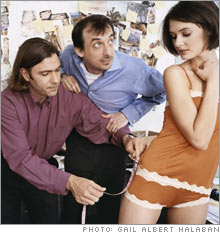
AVENEL, N.J. (FORTUNE Small Business Magazine) - At 9 on an overcast morning, controlled chaos reigns at the headquarters of lingerie merchant Bare Necessities. An unusual team of consultants has just taken over the company's unadorned conference room in Avenel, N.J. One consultant is shoving desks into the center of the room. Others are unpacking gigantic Post-it Notes from boxes and plastering them on the walls.

With furious intensity, two young women are ripping photographs from fashion and lifestyle magazines such as Cosmopolitan and People. What are they looking for? "Anything provocative," one woman replies brusquely.
The company could use a little shaking up. Bare Necessities (barenecessities.com) sold about $15 million in brand-name women's lingerie last year, up from $13.3 million in 2004. The company is profitable, and its four brick-and-mortar boutiques in the Northeast are thriving.

Noah Wrubel, who took over the family business five years ago, sees the Internet as the future of Bare Necessities (80% of its sales are generated online), and he's not happy with his company's position on the underwear superhighway.

Bare Necessities trails market leader Victoria's Secret in both name recognition and online sales. (Victoria's Secret racked up $158 million online in 2004, according to Internet Retailer magazine.) The Bare Necessities site "lacks personality," complains Wrubel. "It has no voice." True, anyone who Googles "women's underwear" will find Bare Necessities high up on the first results page.

Once at the site, she (or even he) will find a crisp, efficient, easy-to-use menu that lists a vast array of bras, panties, nighties, and so forth by size and style. But the same site could just as easily sell paper clips or gardening supplies. "When the transaction is over, I think the customer barely remembers our name," says marketing director Dan Sakrowitz, 37. "If she wound up at a different e-tailer's site the next time, I don't think she'd notice or care."

It's not for lack of effort that Bare Necessities' website lacks a certain panache. Wrubel, 38, a friendly, wiry man with thinning dark hair, says he has assembled Bare's top brass several times and attempted to develop a more memorable online personality. The company even hired branding consultants. "Nothing really worked out," he admits.

Early this year, Bare moved its operations from Newark, N.J., to Avenel, a small town jammed with trucks and warehouses about 15 miles south on the Jersey Turnpike. As soon as they settled in, Wrubel vowed, Bare would sort out its image problems.

That's where FSB came in. We recruited a team of consultants from Frog Design (frogdesign.com), one of the world's most distinguished product-design and branding consultancies. Originally known for its sleek hardware designs (early credits include the first Trinitron TV for Sony (Charts) and one of the first Macintosh personal computers for Apple (Charts)), Frog has lately developed an innovative branding service called FrogTHINK. It's a sort of collective therapy exercise designed to help companies unleash their creative mojo.

The kickoff
At about 9:15 A.M., a thirtysomething Australian named Luke Williams stands up. He is wearing dungarees, an un-tucked white shirt, and a gray sports jacket. If the 15 people in the room had any preconceived notions about FrogTHINK, they are probably wrong, says Williams. "There are no beanbags, no water pistols, no 'trust falls,'" he explains. "Removing inhibitions is not enough to cause creativity. You can't dig a hole in a different place by digging a deeper hole." The underwear merchants absorb the spiel in attentive but baffled silence.

Williams splits the participants into two groups: insiders and outsiders. The insiders are the half-dozen Bare Necessities executives, including Wrubel, Sakrowitz, COO Bill Richardson, and five women executives who requested anonymity because of the intimate subject matter.

Outsiders include a Bare Necessities employee on her first day on the job, a young woman freelancer who occasionally writes copy for the company, and two women recruited from Frog Design's office in New York City.

The purpose of all those "provocative" magazine images (everything from overflowing cans of paint to a camel race in the Sahara) now becomes clear. The insiders are instructed to stay in the room and use the photos to construct one collage that illustrates a customer's real experience of buying lingerie, and another collage of the ideal buying experience.

The outsiders leave the room with the same assignment. Wrubel and Richardson, sitting in a corner, smile as they tackle the chore. "I like looking at pictures," laughs Wrubel. Richardson, 39, a powerfully built man with shoulder-length hair tucked behind his ears, pauses. "The linear mindset in me wants to write a list of adjectives first and find pictures that match," he says.

Capturing customer experience
In 20 minutes both groups post their collages on the wall. Williams asks everyone to explain which picture he chose and why. To Bare Necessities executive David Wauters, 33, a picture of a woman in a helmet suggests beleaguered shoppers, confused by the selection process.

A picture of several round lampshades reminds a dark-haired female marketing manager that real women, unlike models, come in all shapes and sizes. For a blond Bare Necessities employee in her early 20s, a shot of a woman with a halo makes the point that women don't always seek sex appeal when they buy underwear. "Sometimes we just want to be sweet," she explains. For his part, Wrubel posts a photo of open paint cans, "because shopping for lingerie should be colorful."

It soon becomes clear that buying lingerie is enormously frustrating for most women in the room, even those who work at Bare Necessities. Wrubel is astonished to hear that women often throw out a garment they just bought because it turns out to be uncomfortable or unflattering. The young freelancer complains that shopping for underwear is "boring." And a full-figured Bare Necessities executive says the experience can be downright painful. "I try on 100 things and nothing fits," she laments. "I feel shot down."

The first hints of a role - and a brand - for Bare Necessities begin to emerge. The website doesn't do enough to ease the pain of lingerie shopping, muses the freelancer. Couldn't Bare Necessities provide some sort of instant-messenger link on the site so that customers could ask questions or get information about what they're buying?

Williams, from Frog Design, seizing on the halo photograph, wants to know more about sexy vs. sweet. Wrubel admits that Bare Necessities has so far avoided projecting any image at all. "We use photos on the site to sell the product," he says. "It's functional by design, but we don't impact the mood." That sparks a discussion of some famous competitors' websites, which the Bare Necessities crew denounces as "raunchy," "cheap," and "over the line."

Competitive differentiation
Williams asks both teams (insiders and outsiders) to come up with one-word descriptions for three lingerie websites that compete with Bare Necessities. After a few minutes, the outsiders suggest "extravagant," "sexy," "low quality," "curvaceous," "sloppy," "messy," "generic," "too much lace," "too many markdowns," "inexpensive," and "too innocent," among others. Although most of the terms are pejorative, the outsiders note approvingly that one site sets itself apart by offering underwear fashion tips.

In an effort to help Bare Necessities find a distinctive image for itself, Frog strategy director Stuart Hogue, 31, now asks the group to suggest words that mean the opposite of the terms they used to describe their competitors' websites. "It's sort of like the Mad Libs game," he says.

New words go up on the wall. If one rival pushes lingerie brands with a reputation for poor quality, the outsiders declare, Bare Necessities should emphasize its high-end brands such as Versace and La Perla.

Another rival features only drop-dead-gorgeous models? Bare Necessities should demonstrate that it caters to all body types. If a department store chain's website displays only mainstream generic products, then Bare should focus on trendy niche products such as the Scanty line of sleepwear or lingerie from Spoylt, a high-end British manufacturer.

If a third rival is "juvenile," Bare should stand for "sophisticated." "Too innocent," finally, begets "complexity of character and personality."

Frog's Hogue announces that he has spotted a recurring theme: Everyone in the room seems to think that Bare Necessities should provide more guidance to shoppers. Citing Oprah Winfrey's TV book club, Hogue suggests that Bare Necessities position itself as a "sage" for lingerie shoppers.

The freelancer wonders aloud if Bare Necessities should create a wise fictional character to greet and guide visitors to the website. Wrubel riffs on this theme. Make that several characters, he says, representing a shopper in a sexy mood, a functional mood, shopping for a special occasion, etc. " 'Approachable expertise' kinda sums it up," declares Hogue.

At about 4:30, Hogue projects a giant PowerPoint slide on the wall. Created just a few minutes earlier, it resembles an archery target split in three sections by a giant letter "Y." At the center is the word "sage," meaning wise, knowing, of good taste. Floating nearby are the words "intimate," "sensual," and "expertise."

"'Sage' is your core essence," Hogue explains. "It differentiates you from competitors that don't advise or assist their customers." The word "intimate" suggests that Bare Necessities is comfortable with the wide variety of women's bodies. "Sensual" suggests that Bare Necessities can help women be more attractive.

Hogue and Williams then unleash a blizzard of marketing ideas based on the general notion of Bare Necessities as underwear sage. One is a tool that would help shoppers find the bra that matches their current mood (sexy, practical, athletic, etc.) Another is to push fashion and lifestyle tips out to customers, on such themes as how to hide your love handles. Frog marketing director Mick Malisic, 32, proposes hiring handsome men in limousines to deliver lingerie orders in person. (The audience greets this one with friendly but vigorous derision.)

Two weeks after the session, Wrubel reports that Bare Necessities has hired a graphic-design firm to change its website so that it emphasizes the themes of intimacy and expertise. Similarly, the company's newsletter now offers fashion advice as well as special deals. "Instead of just 'free slippers,' it's more 'the ten best bras to go with T-shirts' or 'eight solutions for your prom dress,'" he concludes.

FSB will stay in touch with Bare Necessities and report on the progress of its branding campaign.